

Rebuilding Jawbone So Dental Implants Have a Foundation That Holds
Being told you do not have enough bone for dental implants is not always the final word on the matter. For many patients, bone grafting rebuilds the jawbone to a point where implants become possible. At Citrus Smiles Dental Studio, we perform bone grafting at all five locations in Murphy, Wylie, Heath, Lucas, and Irving, TX, as both a preparatory step for implant placement and as a standalone procedure following tooth extraction. If you are in Royse City, Rockwall, or Fate and want to find out whether bone grafting makes implants an option for you, call us and let’s look at your imaging together.
Contact us now at 972-472-8862 (Murphy), 972-474-3849 (Wylie), 972-433-6500 (Heath), 214-785-8271 (Lucas), or 469-845-9855 (Irving) to book your visit and start protecting your smile!
Bone Grafting at Citrus Smiles: What Sets Our Approach Apart
Bone grafting outcomes depend heavily on the quality of planning that goes into them, and at Citrus Smiles, that planning starts with cone beam CT imaging at the practice level rather than a referral out. We do not send patients to an outside imaging center and wait for results to come back. The 3D scan happens in-house, our team reads it, and the grafting plan is built around what we actually see in your jaw, not a general protocol.
When the same team that performs your graft is also placing your implant months later, they know exactly what was done, how the site healed, and what the imaging showed at every step. There is no handoff, no lost context, and no starting over with a new provider who is reading your chart for the first time.
What Is Bone Grafting?
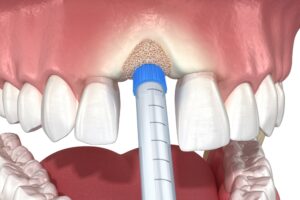 Bone grafting is a surgical procedure that places bone material into an area of the jaw where natural bone volume has been lost. The grafting material, which can come from the patient’s own body, a donor source, animal-derived tissue, or synthetic compounds, integrates with the existing bone over a period of weeks to months and stimulates the growth of new bone. The goal is to rebuild sufficient bone height and width to support a dental implant or to preserve the jaw structure following tooth extraction.
Bone grafting in dentistry is a well-established procedure with a long track record. When performed by a trained team with appropriate imaging and materials, it reliably creates the conditions needed for successful implant placement in patients who would otherwise not qualify.
Why Jawbone Loss Happens
The jawbone needs stimulation from tooth roots to maintain its density. When a tooth is lost or extracted, that stimulation disappears, and the bone in that area begins to resorb, or shrink. The process starts within weeks of tooth loss and continues gradually over time. By the time a patient who lost teeth years ago consults about implants, the bone in those areas may have lost significant volume.
Bone loss can also result from periodontal disease, which erodes bone around tooth roots before the teeth are even gone, facial trauma, or certain medical conditions. In some cases, patients who have worn dentures for years have lost substantial bone because dentures do not replace the stimulation of natural roots.
Types of Bone Graft Materials
Autograft (Your Own Bone)
Bone harvested from another area of your own body, most often the chin, jaw, or hip. Autografts have the highest biological compatibility and typically integrate most predictably. The tradeoff is a second surgical site for the donor bone.
Allograft (Donor Bone)
Processed and sterilized bone from a human tissue bank. Allografts are the most commonly used material in dental bone grafting because they eliminate the need for a donor site on the patient’s body while still providing a scaffold for new bone growth. The processing ensures safety and biocompatibility.
Xenograft (Animal-Derived Bone)
Typically sourced from bovine bone and processed to remove all organic material, leaving only the mineral scaffold. Xenografts are widely used, well-studied, and integrate effectively with human bone tissue. They are a reliable option for many socket preservation and implant-site preparation procedures.
Alloplast (Synthetic Bone)
Man-made materials such as calcium phosphate, hydroxyapatite, or bioactive glass that mimic the mineral composition of natural bone and serve as a scaffold for bone growth. Synthetic grafts eliminate donor site concerns and are a good option for patients who prefer not to use biological materials.
Sinus Lifts vs. Ridge Augmentation: Two Common Bone Grafting Procedures
Not all bone grafting procedures are the same. The approach depends on where in the jaw the bone loss has occurred and how much volume needs to be rebuilt. Two of the most frequently performed grafting procedures at Citrus Smiles are sinus lifts and ridge augmentation, and understanding the difference helps set realistic expectations for your treatment timeline.
Sinus Lift
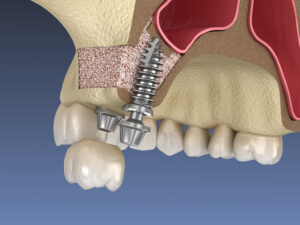 A sinus lift, also called a sinus augmentation, addresses bone loss in the upper jaw below the maxillary sinuses. The sinuses are air-filled cavities that sit just above the back portion of the upper jaw, and when upper teeth are lost, the sinus can expand downward into the space where bone used to be. This leaves insufficient height for implant posts in that region without first creating room.
During a sinus lift, the sinus membrane is gently elevated, and graft material is packed into the space between the membrane and the floor of the sinus. Over the following months, that material consolidates into new bone with enough height to anchor an implant securely. Sinus lifts are one of the most well-documented procedures in implant dentistry, with a strong track record across decades of clinical use.
Ridge Augmentation
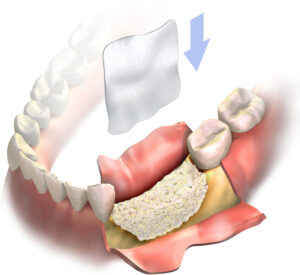 Ridge augmentation rebuilds the width and height of the alveolar ridge, the bony arch that once held your teeth. When multiple teeth are lost or have been missing for an extended period, the ridge can shrink significantly in both dimensions, leaving a narrow or flat shelf of bone that cannot support implants without intervention.
This procedure places graft material along the outer surface of the ridge and is often performed in combination with a membrane that holds the graft in place and guides bone growth. Ridge augmentation is frequently part of a broader treatment plan for patients who lost teeth years ago and are now revisiting implants for the first time, as well as those undergoing full-arch restoration.
When Is Bone Grafting Needed?
Determining whether you need bone grafting before receiving dental implants involves advanced imaging and a consultation with one of our Texas implant dentists at Citrus Smiles Dental Studio.
- Before dental implant placement, when imaging shows insufficient bone height or width to anchor an implant securely
- At the time of tooth extraction, as a method of socket preservation, to prevent bone collapse after the tooth is removed
- After bone loss from periodontal disease, which has left areas of the jaw structurally compromised
- Following jaw trauma or injury, where the bone was damaged or lost
- As part of a full-mouth rehabilitation or complex restorative plan
The Bone Grafting Procedure at Citrus Smiles
- Pre-procedure imaging: We use cone beam 3D imaging to assess existing bone volume, identify the precise area needing augmentation, and plan the graft
- Anesthesia: Local anesthesia is administered to the treatment area; sedation is available for patients who want additional comfort
- Incision: A small incision is made in the gum tissue to expose the underlying bone
- Graft placement: The graft material is placed into the deficient area and shaped to build the necessary bone volume; additional growth factors may be applied to support healing
- Closure: The incision is closed with sutures, and the site is allowed to heal
- Healing period: Over the next several months, the graft integrates with natural bone; follow-up imaging confirms when adequate bone density has been achieved
- Implant readiness: Once healing is confirmed, implant planning and placement can proceed
Socket Preservation: Bone Grafting at the Time of Extraction
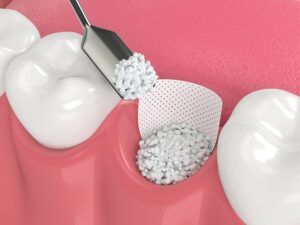 One of the most effective and often underutilized applications of bone grafting is socket preservation, performed at the same appointment as a tooth extraction. When a tooth is removed, the empty socket begins to collapse almost immediately. Placing graft material into the socket at the time of extraction significantly slows that process and preserves the bone volume needed for a future implant.
If you know you are going to eventually replace an extracted tooth with an implant, asking about socket preservation at the time of extraction is worth the conversation. It reduces or eliminates the need for more significant grafting later and often results in a shorter overall treatment timeline.
Recovery and Aftercare
Bone grafting recovery is generally manageable. Most patients experience some soreness, swelling, and minor bruising in the days following the procedure, which can usually be controlled with over-the-counter pain relief or a prescription if needed. A soft diet for the first one to two weeks is recommended to avoid pressure on the graft site. Smoking significantly impairs healing and graft integration and should be avoided throughout the recovery period.
The healing and bone maturation process after grafting takes several months. We will use follow-up imaging to confirm when the graft has integrated to the point that implant placement can move forward. Rushing this step is not in your interest, and we do not skip it.